The Clarinet vs. The Saxophone: A Side-by-Side Comparison
While both the clarinet and saxophone are single-reed woodwind instruments often seen in bands and orchestras, they belong to distinct musical families and offer fundamentally different playing experiences. Understanding their key differences – in history, design, acoustics, technique, and musical roles – is crucial for musicians and enthusiasts. The ubiquitous B\u266D Clarinet serves as our primary clarinet reference point.
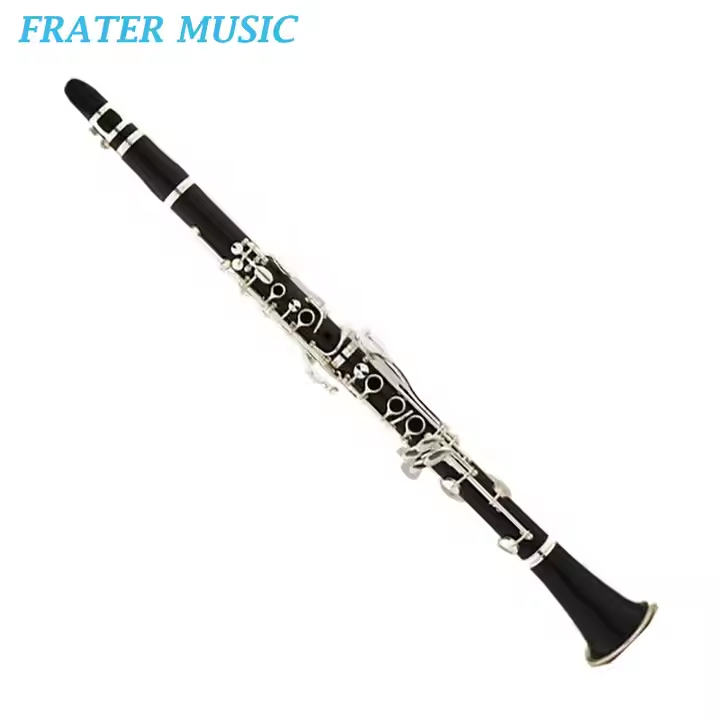
1. Origins & Inventors: Different Centuries, Different Visions
Clarinet: Evolved from earlier single-reed instruments like the chalumeau. Johann Christoph Denner (or his son Jacob) in Nuremberg, Germany, is credited with key innovations around 1700 that created the early clarinet.
Saxophone: A much newer invention. Conceived and patented by Belgian instrument maker Adolphe Sax in Paris in 1846. Sax aimed to create a powerful hybrid instrument bridging the gap between woodwinds and brass.
2. Fundamental Acoustic Design: Bore Shape is Key
Clarinet : Features a cylindrical bore (the internal tube diameter is essentially constant along most of its length). This is the critical acoustic difference.
Acoustic Consequence: Cylindrical bores overblow at the twelfth (an octave plus a fifth). This creates the clarinet's distinctive "register break" between the warm, dark Chalumeau register and the brighter, more focused Clarion register.
Saxophone: Features a conical bore (the internal tube diameter steadily increases from the mouthpiece to the bell).
Acoustic Consequence: Conical bores overblow at the octave. This results in a more uniform timbre across registers and eliminates the pronounced register break found on the clarinet.
3. Materials: Wood vs. Metal
Clarinet (Standard): Traditionally made from wood, most commonly African Blackwood (Grenadilla), though hard rubber (Ebonite) and plastic are common for student models. The B\u266D Clarinet is almost always wood (Grenadilla) at intermediate/pro levels.
Saxophone: Almost exclusively made from brass, usually lacquered or plated (gold, silver, nickel). Some modern variants use bronze, copper, or other alloys, but the fundamental construction is metal.
4. Keywork & Mechanics: Complexity vs. Uniformity
Clarinet :
Utilizes the Boehm system (most common) or Oehler system (primarily Germany/Austria).
Keywork covers tone holes primarily via ring keys (covering holes directly in the body) and padded cups.
Features numerous cross-fingerings and alternate fingerings, especially in the throat tones and around the register break.
The register key shifts the pitch up a twelfth. Pinky keys (for little fingers) are complex and require significant dexterity.
Saxophone:
Primarily uses a derivative of Sax's original design, often refined (e.g., Selmer's Balanced Action, Super Action 80).
Keywork relies heavily on padded cups connected by rods and levers. Tone holes are raised from the body tube.
Fingering system is generally more uniform and logical across its entire range, with fewer awkward cross-fingerings compared to clarinet. Overblows cleanly at the octave with a single octave key mechanism.
Pinky keys (table keys) are typically simpler and ergonomically grouped.
5. Embouchure & Air Support: Focus vs. Openness
Clarinet :
Requires a firmer, more focused embouchure. The lower lip is drawn back slightly over the lower teeth, applying significant pressure to the reed and mouthpiece facing.
The mouthpiece tip opening is generally smaller. Reed strength is typically higher (e.g., 3, 3.5, 4).
Demands strong, steady air support, particularly to project in the lower register and to navigate the resistance across registers.
Saxophone:
Utilizes a softer, more relaxed embouchure. The lower lip acts more as a cushion/support rather than being tightly pulled back. The jaw is generally lower.
The mouthpiece tip opening is generally larger. Reed strength is typically lower (e.g., 2, 2.5, 3).
Requires fast, warm air to fill the larger conical bore and produce the characteristic saxophone sound. Resistance is generally perceived as lower than clarinet.
6. Sound & Timbre: Purity vs. Edge
Clarinet :
Produces a sound often described as pure, clear, woody, mellow, or focused.
Capable of extreme dynamic range and nuance, from a whisper to a powerful forte.
Has a unique hollow, dark character in the Chalumeau register and a penetrating, singing quality in the Clarion register. The altissimo register is very challenging.
Lacks significant even-numbered harmonics due to its cylindrical bore, contributing to its "purer" sound.
Saxophone:
Produces a sound characterized as rich, warm, bright, brassy, edgy, or vocal.
Has a naturally louder fundamental output, designed to project.
Offers a more consistent timbre throughout its range, though distinct characters exist between soprano, alto, tenor, baritone, etc.
Strong even-numbered harmonics due to the conical bore, contributing to its "fuller," more complex sound with inherent edge/buzz.
7. Transposition & Range
Clarinet:
Primarily a transposing instrument. The b flat clarinet is the most common: when it plays a written C, it sounds as a B\u266D (a whole step lower). Other common types: A Clarinet (sounds minor 3rd lower), E\u266D Clarinet (sounds minor 3rd higher).
Standard Range: Approximately 3.5 octaves (from written E3 or D3 below the staff to C7 or higher), utilizing distinct Chalumeau, Clarion, and Altissimo registers.
Saxophone:
Always a transposing instrument. Common types: Soprano (B\u266D), Alto (E\u266D), Tenor (B\u266D), Baritone (E\u266D). An Alto Sax playing written C sounds as E\u266D (a major 6th lower).
Standard Range: Approximately 2.5 octaves (written B\u266D3 to F\u266F6 or F6). Extensions (altissimo) are common in jazz/modern playing.
8. Musical Roles & Genres
Clarinet :
Core Orchestral Instrument: Essential in classical symphony orchestras, wind ensembles, and chamber music (e.g., Mozart, Brahms, Copland).
Woodwind Quintet Staple: Forms the core sound with flute, oboe, bassoon, and horn.
Traditional & Folk Music: Klezmer, Dixieland jazz (early), folk ensembles.
Concert/Military Bands: Principal soprano woodwind voice.
Limited Role in Modern Jazz: Primarily Dixieland, Swing Era (Benny Goodman), some contemporary classical/jazz fusion.
Saxophone:
Jazz Icon: The quintessential voice of jazz (Charlie Parker, John Coltrane, Sonny Rollins). Found in big bands, combos, solos across all subgenres.
Wind Band/Marching Band Core: Alto, Tenor, and Baritone saxes are fundamental.
Popular Music: Rock, pop, funk, soul, R&B horn sections.
Orchestral Use: Occasional, primarily as a color instrument (e.g., Ravel's Bolero, Bizet's L'Arlésienne). Not a standard section member like the B\u266D Clarinet.
Solo & Chamber Repertoire: Growing classical repertoire, saxophone quartets.
9. Learning Curve & Switching Between Them
Initial Learning: Saxophone is generally considered easier to start. The logical fingering, uniform registers, and less demanding initial embouchure allow faster production of a satisfying sound. The B\u266D Clarinet presents immediate challenges with the register break, complex pinky system, and firmer embouchure.
Mastery: Both instruments present significant challenges at advanced levels (intonation, tone refinement, extended techniques, altissimo).
Switching: Musicians often double on both. However:
Clarinet to Sax: Adjusting to the looser embouchure and larger mouthpiece/reed can take time. Sax fingerings feel simpler initially.
Sax to Clarinet: The tighter embouchure, register break, complex fingerings (especially pinky keys), and voicing required for the clarion/altissimo registers present significant hurdles. The B\u266D Clarinet's smaller mouthpiece feels restrictive.
Conclusion: Distinct Voices, Complementary Worlds
The clarinet and the saxophone, despite sharing a single reed, are fundamentally different instruments. The clarinet's cylindrical bore creates its unique register break and pure, woody tone, demanding precision in embouchure and fingering. It reigns supreme in classical settings. The saxophone's conical bore delivers a rich, powerful, and consistent sound across registers with more ergonomic keywork, making it the undisputed king of jazz and popular music.
Choosing between them depends on musical goals: the orchestral tradition and nuanced classical repertoire favor the Clarinet, while the expressive power and central role in jazz/pop beckon saxophonists. While doubling is common, each instrument requires dedicated practice to master its distinct physical and musical demands. Understanding these profound differences allows for a deeper appreciation of both remarkable instruments and their unique places in the musical landscape.
Contact us for information about factory information and service.