The bugle horn (or simply "bugle") is one of the oldest and purest brass instruments. With no valves, keys, or slides, it relies entirely on the player's embouchure (lip control) and air to produce its iconic military and ceremonial calls. Mastering it demands focus, ear training, and physical discipline. Here's how to start:
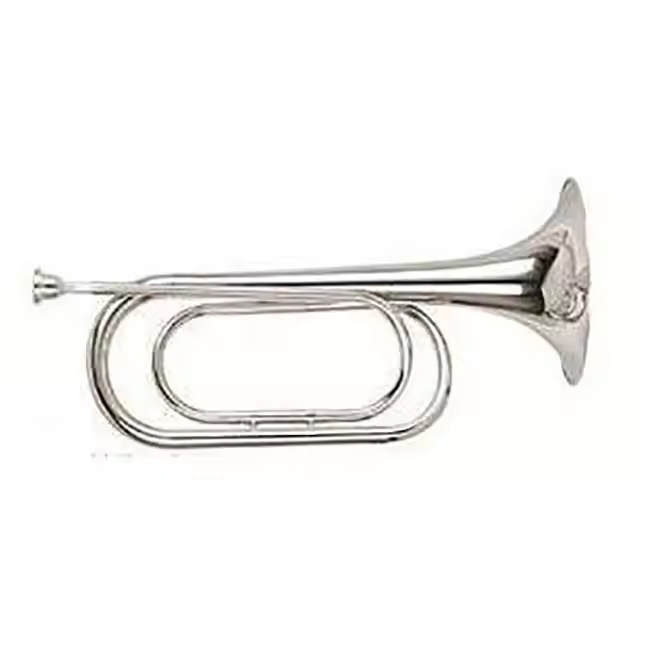
1. Understanding the Bugle Horn:
-
No Valves, No Compromises: The defining feature of the bugle horn is its complete lack of valves or other pitch-altering mechanisms. Pitch is controlled solely by the tension and vibration speed of the player's lips against the mouthpiece, combined with air speed and support.
-
The Harmonic Series: The bugle can only play notes from the natural harmonic series based on its fundamental pitch (usually B\u266D or G for modern bugles). The common notes (starting from the fundamental "low C" up) are:
-
C (fundamental, often weak)
-
C (octave)
-
G
-
C
-
E
-
G (often sharp)
-
B\u266D (often flat)
-
C (high)
-
D
-
E
-
F\u266F (very sharp) / G
-
Range: Typically spans about 4-6 usable notes for standard calls (e.g., Taps, Reveille), though skilled players can reach higher partials.
-
Sound: Characterized by its clear, penetrating, and often poignant tone, designed to carry over distance.
2. Essential Gear:
The Bugle Horn: Choose a standard B\u266D bugle (most common). Ensure it's clean inside and out. The mouthpiece receiver should be standard size.
Mouthpiece: Use a standard, shallow-cup, V-shaped military bugle mouthpiece (e.g., Bach 11, 12, or 15). Avoid deep orchestral mouthpieces. Clean it thoroughly before use.
3. Forming the Embouchure (The Foundation):
Mouth Position: Say "Mmm" or "Em". Keep corners firm and pulled slightly back/down, like a slight frown. Avoid puffing cheeks.
Lip Placement: Center the mouthpiece comfortably on your lips (roughly 50% top lip, 50% bottom lip, adjusted slightly for comfort). Apply even, firm pressure inward from the corners, not downward jaw pressure.
Aperture: Create a small, focused opening between your lips in the center. Imagine blowing a fast, cold airstream through a tiny straw.
Chin: Keep chin flat and down, creating a stable platform.
4. Producing Your First Sound ("Buzzing"):
-
Without the Bugle: Practice buzzing just the mouthpiece.
-
Form your embouchure firmly on the mouthpiece.
-
Take a deep, low breath (diaphragmatic breathing - stomach expands).
-
Blow steady, fast air through the aperture while maintaining firm lip tension. Aim for a clear, consistent, high-pitched buzz. Start trying to change pitch by altering lip tension (tighter = higher pitch, looser = lower pitch) and air speed (faster = higher).
-
With the Bugle: Once you can buzz steady pitches on the mouthpiece, insert it firmly into the bugle. Repeat the buzzing process. The bugle amplifies the buzz into a clear tone. Focus on producing the clearest, steadiest tone possible on a single note (start with the 2nd C or G).
5. Playing the Harmonic Series:
-
The Core Skill: Changing notes on the bugle horn means "lipping up" or "lipping down" to the next harmonic.
-
How it Feels:
-
To Ascend: Firm corners more, increase lip tension significantly, focus the aperture smaller, increase air speed (not just volume). Think "tee" or "eem" internally.
-
To Descend: Relax lip tension slightly (keep corners supportive), open the aperture slightly, decrease air speed (keep support). Think "toh" or "aah" internally.
-
Start Simple: Practice moving between two adjacent notes in the series (e.g., Middle C -> G, or G -> High C). Listen intently for the note to "slot in" cleanly. Avoid sliding or smearing.
6. Mastering the Air:
-
Diaphragmatic Breathing: Breathe deeply into your lower abdomen/stomach, expanding sideways and back. Avoid shallow chest breathing. This provides the massive air support needed.
-
Fast, Focused Air Stream: The air must move quickly to excite the lips and resonate the bugle. Imagine blowing to cool hot soup fast. Support comes from the engaged diaphragm and core muscles.
-
Steady Air Column: Maintain constant, uninterrupted air pressure from the diaphragm through the note. Don't let the air stream waver.
7. Playing Bugle Calls:
-
Ear Training is Paramount: You must learn the melodies by ear. Sheet music shows the rhythm and note names, but your ear tells you if you're hitting the correct harmonic. Listen to flawless recordings constantly.
-
Know the Notes: Memorize which harmonics are used in standard calls (e.g., Taps uses G, C, E, G; Reveille uses G, C, E, G, High C).
-
Focus on Rhythm & Articulation: Military calls demand precise rhythm and clean articulation (tonguing).
-
Practice Slowly: Break calls into short phrases. Play painfully slow with a metronome to ensure perfect pitch accuracy and rhythm before speeding up.
8. Intonation (Tuning) Challenges:
-
Natural Imperfections: Some harmonics are naturally out-of-tune with equal temperament (e.g., the 7th partial B\u266D is flat, the 6th partial G is sharp).
-
The Player's Role: You must actively adjust these notes using your embouchure and air:
-
To Raise a Pitch: Increase lip tension, focus the aperture smaller, increase air speed.
-
To Lower a Pitch: Relax lip tension slightly, open the aperture slightly, decrease air speed.
-
Listen Relentlessly: Constantly compare your pitch to a reference (recording, tuner, drone note). Develop the sensitivity to hear when a note is out and correct it instantly.
9. Practice Routine:
-
Warm-up (Mouthpiece): 2-3 mins buzzing long tones, sirens (glissandi), and simple intervals.
-
Warm-up (Bugle): 5 mins playing long tones on each fundamental harmonic (C, C, G, C, E). Focus on pure tone, steady pitch.
-
Lip Slurs: Practice moving cleanly between harmonics (e.g., Low C -> Mid C, Mid C -> G, G -> High C, High C -> E). Focus on instant note changes without smearing.
-
Scale Fragments: Practice the arpeggios inherent in the harmonic series (e.g., C-G-C-E-G).
-
Call Practice: Work on specific calls phrase by phrase, slowly. Focus on pitch accuracy, rhythm, articulation, and dynamics.
-
Cool-down: Gentle long tones and lip buzzing to relax.
10. Common Challenges & Solutions:
-
No Sound/Weak Sound: Not enough lip tension, aperture too open/closed, insufficient air speed/support, mouthpiece placement wrong. Refocus embouchure, increase air speed from diaphragm.
-
Cracking Notes: Embouchure collapsing mid-note, inconsistent air support, trying to force a note without the right lip tension/air speed. Practice long tones, ensure steady air from the core.
-
Poor Tone (Fuzzy, Airy): Aperture not focused, lips not vibrating freely, insufficient air speed. Firm corners, focus the buzz, increase air speed.
-
Difficulty Hitting Higher Notes: Corners not firm enough, lip tension too low, aperture too large, air too slow. Increase corner firmness and lip tension significantly, focus aperture, blow faster air with diaphragm support. Do not use jaw pressure.
-
Notes Out of Tune: Not listening critically, not adjusting embouchure for problematic harmonics (7th B\u266D flat, 6th G sharp). Practice with a tuner/drone, learn to bend notes up/down.
Why the Bugle Horn Endures:
Playing the bugle horn connects you to centuries of tradition. Its valveless purity demands raw skill and musicality, producing a sound that cuts to the core. By mastering your embouchure, air, and ear, you unlock the power to sound Taps, Reveille, and other calls with the dignity and clarity they deserve. It’s a challenging, rewarding pursuit that builds discipline and musical connection unlike any other instrument. Start buzzing!
Contact us for information about factory information and service.